Education Portal · Latest Videos
Open Education Portal
D2b_subtitled
Leadless Pacemaker, S-ICD and CRT on Chest X-ray: Special Device Systems | Cardiac Devices 2B
Question Bank · Cases
 Case #521
A 60 years old male with pmh of CRT-D implantation last year,presented with this ECG. he had episodes of dizziness.
the ECG and CXR are shown below.
Which statement is correct?
Case #664
A middle aged lady,came to our clinic with chief complaint of multiple episodes of palpitation.
here are the EP tracings.
Which arrhythmia is the least possible diagnosis?
Case #667
A middle-aged woman with a history of migraine headaches presented to the emergency department with a primary complaint of syncope and severe headaches on the day of admission. Her medication history includes sumatriptan and methadone, both of which she had increased in dosage due to exacerbation of her headaches.
Here are the ECGs
What is the best action towards the patient?
 Case #668
A 50-year-old woman was referred for an electrophysiology study due to frequent episodes of palpitations. Arrhythmia was induced with programmed stimulation, and below you can find tracings.
Which diagnosis is most probable?
 Case #666
A middle-aged man with MVR, EPS performed, Below are the findings: ECG during arrhythmia, EP tracings, fluoroscopic imaging, and sinus rhythm ECG.
What is the best explanation?
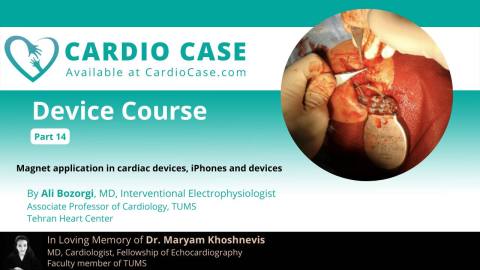
Device course part 14
Magnet application in cardiac devices, iPhones and devices
Watch VideoCase #665
A middle-aged man with MVR, EPS performed, Below are the findings: ECG during arrhythmia, EP tracings, fluoroscopic imaging, and sinus rhythm ECG.
What is the best explanation?
Case #663
A middle-aged man with a history of accessory pathway ablation came to our clinic with chief complaint of recurrent palpitations.
(ECG:1-2)
He was scheduled for EP study, and the accessory pathway was successfully ablated.
The day after, he was complaining of pleuritic chest pain.(ECG :3)
Bedside echo revealed mild pericardial effusion.
which statement is not correct?
Case #662
During electrophysiology study, arrhythmia is easily induced with atrial burst pacing. You can find the tracing in below.
what is the correct statement?
Case #661
A 35-year-old man was referred for an electrophysiology study due to multiple episodes of PSVTs. During EPS arrhythmia was easily induced, which you can find below as tracing A. After localizing the best signal, with RF application the retrograde activation of arrhythmia changed (tracing B).
According to tracing A and B, which statement is correct?
Case #660
54 years old woman was referred for electrophysiology study, due to multiple episodes of sudden palpitations. The arrhythmia was induced via atrial burst pacing.
Below you can find tracings of arrhythmia.
Which diagnosis is least possible?
Dr. Maryam Khoshnevis
MD, Cardiologist Fellowship of Echocardiography Faculty member of TUMS