Education Portal · Latest Videos
Open Education Portal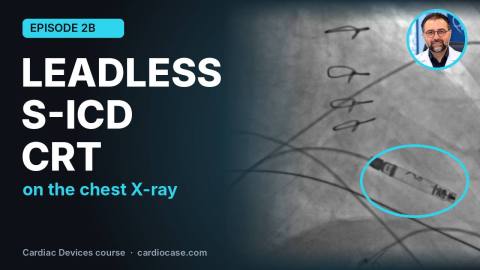
D2b_subtitled
Leadless Pacemaker, S-ICD and CRT on Chest X-ray: Special Device Systems | Cardiac Devices 2B
Question Bank · Cases
 Case #505
A female patient aged 53 years, with a medical history of aortic valve replacement (AVR), mitral valve replacement (MVR), and tricuspid valve repair (TVr) five years ago, presented at the medical facility without any symptoms but with a prolonged withdrawal from warfarin for several months. The patient was admitted, and heparin therapy was initiated along with a transthoracic Doppler echocardiography (TDI TTE) examination and fluoroscopy.
Based on the results obtained from the TDI TTE and flouroscopy what do you consider the most appropriate course of action?
 Case #501
A 68-year-old woman with history of diabetes mellitus, peripheral arterial disease, and breast cancer is referred to your outpatient clinic for decision regarding antithrombotic agents. In laboratory findings, creatinine and platelet count were 0.9 mg/dL and 88,000 × 109/L, respectively.
She was receiving Aspirin 80 mg daily, Rivaroxaban 2.5 mg BD, Pantoprazole 40 mg daily, Atorvastatin 40 mg BD, and Empagliflozin/Linagliptin 10/5 mg daily. Her chemotherapy regimen was Docetaxel + Carboplatin + Trastuzumab.
Which is your preferred antithrombotic regimen?
 Case #503
A 40-year-old woman has been complaining of refractory HTN for the last year. She goes to the heart clinic. After taking three classes of antihypertensive drugs, her blood pressure is still not controlled. Additional imaging is done for the patient, who is a candidate for renal artery angiography.
Based on the diagnosis which sentence is false?
 Case #502
A 38-year-old with palpitation.ECG during palpitation is shown:
What is the most probable diagnosis?
Case #498
A 60-year-old male patient with a history of hypertension, hyperlipidemia, and smoking was admitted to the hospital two days ago, with a diagnosis of anterior MI, and underwent primary percutaneous coronary intervention (PCI) to his left anterior descending artery (LAD).
Two days after the PCI, the patient developed symptoms of heart failure, including dyspnea, cough, and fatigue. His blood pressure was 90/60 mmHg, and his heart rate was 110 beats per minute. Physical examination revealed crackles in both lung fields and holosystolic murmur. His ECG and echocardiography are shown below.
Based on ECG and echocardiography, which option is more likely to be diagnosed?

Case #500
An EP tracing of a patient with AVNRT is shown below:
What is your interpretation for the beat mentioned?
Case #499
An 80 year old asymptomatic lady came with below ECG:
What is your diagnosis?
Case #497
A 32-year-old male presents to the cardiology clinic with a history of palpitations and syncope. He reports that he has been experiencing these symptoms for the past six months, and they have been increasing in frequency and severity. He denies any chest pain or shortness of breath.
A transthoracic echocardiogram (TTE) reveals mild dilatation of the right ventricle (RV) with reduced RV function and an ejection fraction of 40%. The left ventricle (LV) is normal in size and function.
The EKG is shown.
Based on the diagnosis, which one is correct?
Case #496
A patient came to the Emergency department with dizziness, she was implanted with a dual-chamber pacemaker a year ago. Below you can find the ECG of the patient and Chest X-Rays of the implantation date and a new one.
Which statement is NOT correct?
Case #495
A middle-aged man with ischemic cardiomyopathy and ICD implantation came with ICD firing. Programming performed.
Tracings are shown below.
Which statement is NOT correct?
Dr. Maryam Khoshnevis
MD, Cardiologist Fellowship of Echocardiography Faculty member of TUMS